
From the street, it is easy to forget you are in the middle of San Francisco. The eucalyptus trees rise above tangled green undergrowth, fog softens the trails, and the city’s sounds can suddenly feel very far away. Sutro Forest, on Mount Sutro, has a reputation as one of San Francisco’s most haunted places. In my experience, it is a place where the setting, the documented tragedies and the possibility of unexplained activity combine into a particularly unsettling investigation. But a reputation is not evidence that the forest is literally America’s most haunted.
I’m Tim Wood, the founder of LiveSciFi.tv. When I investigated Sutro Forest alone at night for The Ghost Hunter, I set out to document my experiences on camera rather than rely only on the stories. I want to put those firsthand experiences alongside the documented history that gives this part of San Francisco its darker reputation.
Where Is Sutro Forest in San Francisco?
Sutro Forest is the woodland on Mount Sutro, overlooking the Parnassus Heights area of San Francisco. Much of its publicly accessible landscape is protected as the Mount Sutro Open Space Reserve, which is owned and managed by the University of California, San Francisco (UCSF). It is a real urban nature preserve, not an abandoned forest or a designated paranormal attraction. UCSF describes a network of more than five miles of trails for the public.
The combination of tall eucalyptus, coastal fog, changing light and winding paths creates a powerful atmosphere—especially for anyone who has heard the ghost stories. These natural conditions are worth documenting during a paranormal investigation because shadows, falling moisture, wind and distant sounds can resemble something much stranger on video or audio.
Why Was Sutro Forest Planted?
The site’s history does not begin with a haunting. According to UCSF’s history of Mount Sutro, Adolph Sutro began planting trees here in 1886 for San Francisco’s first Arbor Day. Species included blue gum eucalyptus, Monterey pine and Monterey cypress. The hill had previously supported native grasses, wildflowers and shrubs; it was not an untouched, centuries-old eucalyptus forest.
Adolph Sutro later served as San Francisco mayor and had extensive property interests in the city. Over the following decades, logging, a twentieth-century fire, university acquisition and conservation management transformed the hill. UCSF acquired a substantial part of the property in 1953 and designated a permanent open-space area in 1976. Today the preserve is managed for ecological health, public access and safety—not paranormal tourism.
The Documented Dark History of Sutro Forest
The haunting stories are often introduced with sweeping claims about murders and countless deaths. Those claims require more care. Historic San Francisco newspapers really did report suicides and the discovery of human remains in Sutro Forest and nearby hillsides around the turn of the twentieth century. That historical record is disturbing enough without inventing victim counts, assigning supernatural causes or asserting that every rumored murder took place here.
One important independent collection is Rex Bell’s 2011 essay, “The Ghosts of Sutro Forest,” published by the Western Neighborhoods Project. Bell located and reproduced historic newspaper accounts, including coverage from the San Francisco Call. The examples below are paraphrased and attributed rather than copied from those reports. The San Francisco Public Library’s historical newspaper guide also explains where original Call editions can be researched.
1899: Grant Bell and a case of mistaken identity
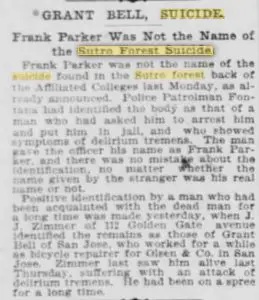
A particularly revealing story involved a man whose remains were discovered in the Sutro woods in December 1899. Initial reporting identified him as Frank Parker, but a subsequent San Francisco Call correction published on December 21, 1899 identified him as Grant Bell, a former bicycle repairer from San Jose. The newspapers linked the death to suicide. The change in identification is itself a lesson in responsible research: contemporary reporting was not always complete or accurate the first time.
1904: Newspaper reports of deaths near the old Almshouse
On March 26, 1904, the San Francisco Call described a death investigation in woodland near the Almshouse and the recovery of an unidentified man’s remains. Then, on April 18, 1904, the newspaper reported the death of Thomas Murnane, a former Almshouse resident whose remains had been discovered in the forest. The reports establish that these deaths were documented at the time. They do not establish that the people involved became ghosts or that their deaths caused later experiences.
A separate November 24, 1904 report concerned Daniel Pfeefer, a baker whose wife searched for him before his body was found in the Sutro woods. Contemporary accounts often described poverty, bereavement, illness and despair in sensational language. We should read them as evidence of human lives and loss, not as entertainment or proof of a curse.
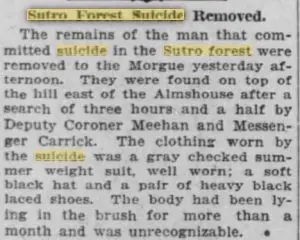
These are selected documented cases, not a verified total. The old papers and the Western Neighborhoods Project offer a better starting point than vague claims of “hundreds of suicides” or murders. There is no reliable evidence that deaths at the site create residual or intelligent spirits.
How the Almshouse Fits Into Sutro Forest History
Several of the historical accounts refer to the San Francisco Almshouse or the road that ran near it. The old institution served people who were impoverished, ill or otherwise unable to support themselves, in an era with very different social protections and health care. Its proximity helps explain why the Almshouse appears in the newspaper record. That association should never be used to reduce former residents to faceless “lost souls” for a ghost story.
When I investigate somewhere with a history like this, I want to know the actual people and dates, not just the broad outline of a terrifying legend. Research like this also clarifies which parts of an event happened inside the forest, nearby or elsewhere in the city.
My Overnight Paranormal Investigation at Sutro Forest
For an episode of The Ghost Hunter, I spent time alone in the forest after dark with recording equipment. Almost immediately the location felt different to me. I had a persistent sensation that something was nearby, and as I continued along the eucalyptus-lined trails I experienced several moments that I could not confidently explain in real time.
During the investigation I recorded sounds that I considered possible electronic voice phenomena (EVPs), noted unusual readings on my equipment and believed I saw fleeting dark shapes moving among the trees. At one point I thought I saw a figure wearing a gown on the trail before it disappeared from view. That was my experience and interpretation; it is not a verified identification of an apparition or a former Almshouse resident.
Forest investigations also have important limitations: wind and tree branches can produce unexpected sounds; condensation can strike clothing or microphones; passing wildlife can move suddenly across a beam of light; and handheld meters can react to equipment or nearby environmental sources. The right way to examine a purported EVP or shadow figure is to retain the original recording and review the context before labeling it paranormal.
What stayed with me was the combination of the place’s atmosphere, the real history and the uncertainty of what I had recorded. That is why I recommend watching the episode itself rather than treating any one account as conclusive proof.
Watch Tim Wood Investigate Sutro Forest: The Ghost Hunter
The original 2020 episode, “The Ghost Hunter – Ghosts of Sutro Forest – Episode 1,” documents my on-location investigation. It gives viewers a chance to hear the audio and see the conditions rather than simply accept a written claim.
Watch the Sutro Forest investigation directly on YouTube → or explore more episodes of The Haunting on LiveSciFi.
So, Is Sutro Forest Actually Haunted?
Sutro Forest is sometimes marketed as “the most haunted forest in America,” including in the original title of this article. That is an expression of paranormal reputation and my interest in investigating it—not an objectively established ranking. The historical deaths are supported by newspaper reporting. The allegations of ghosts, demons and voices remain experiences and interpretations that require separate assessment.
For me, a compelling investigation does not require pretending the evidence is stronger than it is. Sutro Forest deserves to be understood as a living public landscape, a place with documented tragedies and an environment where unusual experiences can feel extremely convincing. I remain interested in what was recorded during my visit, and I welcome viewers to examine the footage themselves.
Visiting Mount Sutro Responsibly
If you want to understand the setting, visit during permitted public-access hours, stay on established trails and check UCSF’s current closure notices before going. Do not enter closed or unsafe areas, disturb historical locations, film strangers without permission or treat the forest as a place to stage dangerous nighttime stunts. For current trail information and habitat management, consult UCSF’s Mount Sutro Open Space Reserve page.
Explore More LiveSciFi Haunted Locations
- The Haunted History of Waterdog Lake — another location where history and on-site investigation intersect.
- Fractured History of the Haunted Monroe House — the documented history behind an Indiana haunted-house investigation.
- Welles House: A Haunting Worse Than Amityville? — historic research and LiveSciFi footage.
- Haunted McEwan Road of Port Costa — my firsthand investigation of the Lady in Red legend in Northern California.
- The Haunting Episodes — explore related original video investigations.
Sources and Editorial Notes
- Rex Bell, “The Ghosts of Sutro Forest,” Western Neighborhoods Project (2011) — historically attributed newspaper extracts and a distinct first-person essay; this article does not reproduce that essay.
- San Francisco Public Library, Digitized Historical Newspapers — guidance for reviewing primary editions of the San Francisco Call.
- UCSF, Mount Sutro Open Space Reserve — the site’s history, land management and public access.
- UCSF (July 2026), reserve restoration and visitor use — contemporary management context added in the 2026 update.
- LiveSciFi / Tim Wood, The Ghost Hunter: Ghosts of Sutro Forest, Episode 1 (2020) — first-hand recording.
Historical reporting documents deaths; it does not establish paranormal causation. First-person descriptions of EVPs, figures or encounters are identified as Tim Wood’s own observations. Photo and archival-media credits: materials uploaded to the LiveSciFi media library; historical newspaper text independently contextualized by the sources linked above.
Join the Conversation
Have you experienced something unexplained? Share your thoughts and experiences with the LiveSciFi community.