
By Tim Wood, founder of LiveSciFi.tv.
When Hereditary arrived in theaters in 2018, one detail immediately interested me: the horror film didn’t simply invent its demonic antagonist. Paimon—also spelled Paymon or Peymon—is a named spirit in historical Western occult texts. That does not prove a demon exists in the real world, but it does mean writer-director Ari Aster drew on an older body of supernatural lore.
I’ve spent years investigating reports of demonic activity for LiveSciFi, and I’m always interested in the point where a horror movie borrows from an actual document. In this case, the Ars Goetia supplies the name, a royal rank, a sigil, a procession of musical instruments, and striking descriptions of the figure later called King Paimon. Which details did Hereditary use—and which did it turn into fiction?
Quick answer: Paimon is historically documented as a figure in demonological literature, including the Lesser Key of Solomon. Whether Paimon exists as a supernatural being is a matter of belief and interpretation, not an established fact. Hereditary incorporates recognizable occult imagery but tells its own fictional story.
Spoiler warning: the article discusses major events from Hereditary (2018).
The Real History of the Demon Paimon
In the Ars Goetia, the first book of the Lesser Key of Solomon or Lemegeton, Paimon is listed as the ninth of 72 spirits and described as a great king. The Lesser Key is an early modern compilation of magical material, not a document written by the biblical Solomon himself. Its surviving texts belong to a much later occult tradition.
The description in the classic Mathers and Crowley edition portrays Paimon as a crowned figure riding a dromedary, preceded by musicians with trumpets, cymbals and other instruments. It describes an unusually powerful voice, says Paimon can impart knowledge and dignities, and attributes command of 200 legions of spirits to the figure. Those numbers and titles describe a hierarchy inside the grimoire’s tradition; they are not independently verifiable information about a supernatural army.
Other texts, including Johann Weyer’s Pseudomonarchia Daemonum, traditions associated with the Book of Abramelin, and the later Dictionnaire Infernal by Jacques Collin de Plancy, also help explain why the name persisted across centuries. Their portrayals are not identical, and their relationship to one another is more complicated than a single unbroken account.
If you want to examine the original wording, read the public-domain edition of The Lesser Key of Solomon on Project Gutenberg; search for “Paimon” in its Goetia section. For a broader comparison, see our A–Z demon names guide and historical demon classifications.
What Is the Paimon Symbol in Hereditary?
The symbol of Paimon, commonly called a sigil or seal, is an especially recognizable detail in Hereditary. In Western ceremonial-magic manuscripts and later printed editions, named spirits appear alongside distinctive line drawings or characters. A sigil functions as a symbolic identifying mark within that literary and ritual tradition.
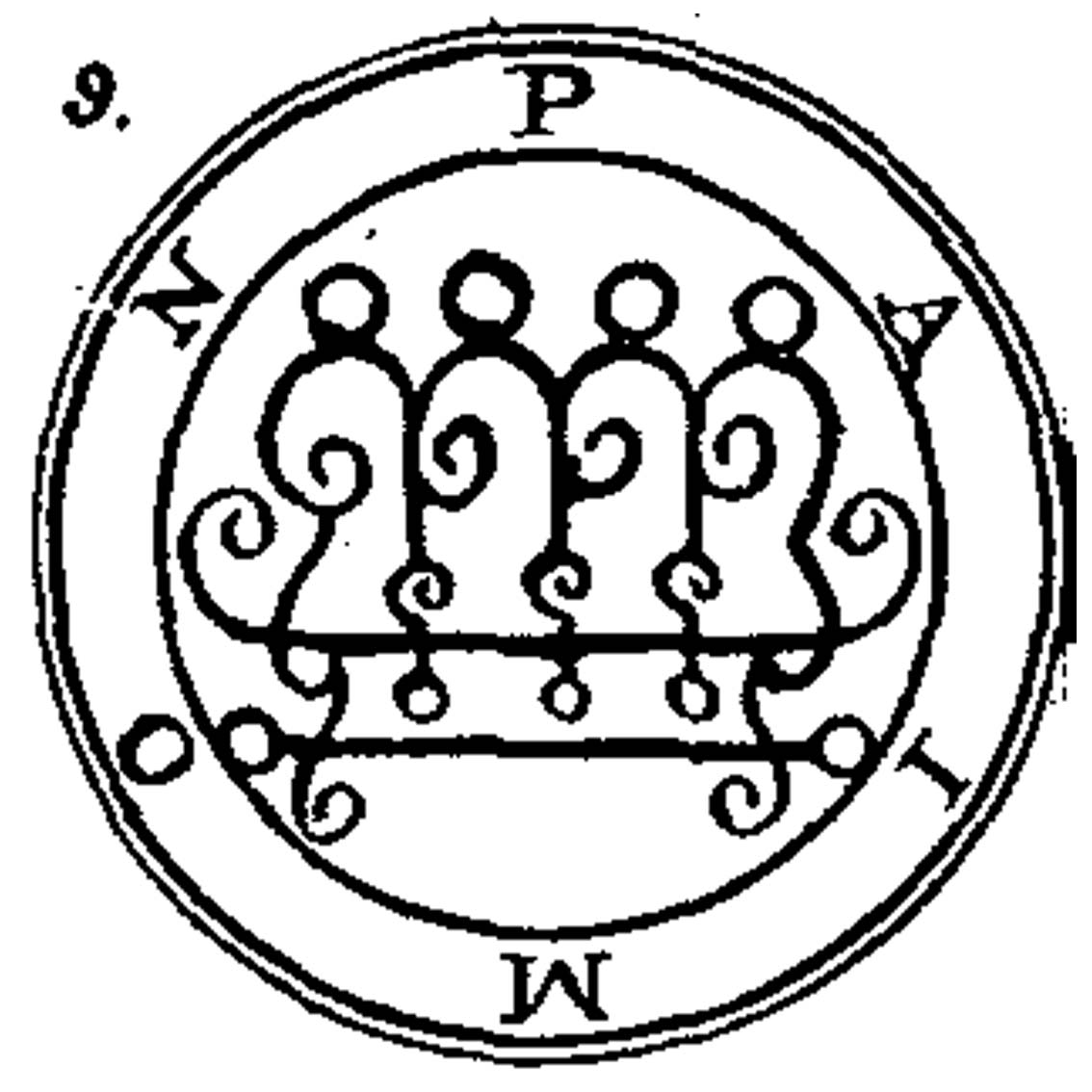
The film uses imagery associated with this occult tradition as a visual clue connecting the family to the group worshipping King Paimon. My original 2018 article highlighted the sigil because, unlike much of the film’s supernatural action, the underlying historical symbol can be compared against printed sources.
There is also an important distinction: a movie showing an adapted sigil is not a demonstration that the symbol can summon anything. It is a recognizable piece of historical iconography employed in a work of fiction.
How Accurately Does Hereditary Portray King Paimon?
Ari Aster’s Hereditary centers on Annie Graham and her family, whose increasingly disturbing experiences become entangled with the legacy of Annie’s mother, Ellen. The 2018 film was written and directed by Aster and distributed by A24. For the official synopsis, visit A24’s Hereditary page.
The movie borrows specific recognizable details, but it also reshapes them to serve its story. Here is how I separate the grimoire material from the screenplay:
| Detail | Historical occult texts | Hereditary |
|---|---|---|
| Name and rank | Paimon is described as a king among the Goetic spirits | A cult seeks to enthrone King Paimon |
| Sigil | Printed seal associated with the spirit | Occult markings connect people and events |
| Sounds | Trumpets, cymbals and an extraordinary voice | Sound becomes part of the film’s unsettling imagery |
| Powers | Attributed knowledge, status and command over spirits | The cult hopes to gain wealth and power |
| Human host and sacrifice | The Goetic passage does not narrate the Graham family’s possession plot | A central fictional mechanism driving the horror |
I think this comparison is what makes the film interesting for readers curious about demonology. Some of the background has a traceable literary history; the terrifying events on screen remain a deliberately constructed horror narrative.
Why Do Bells and Strange Sounds Matter in Hereditary?
One of the details in my original article was an interpretation of the movie’s tinkling or bell-like sounds. It is tempting to connect every unsettling audio cue to the trumpets and cymbals in the Goetia, or to modern theories about the etymology of Paimon’s name.
The narrower conclusion is more defensible: musicians and loud sounds are explicit features of the grimoire’s Paimon account, while the soundtrack and sound design in Hereditary provide an atmospheric cinematic parallel. Claims that Paimon definitely means a “tinkling sound,” or that the figure originated as the Egyptian goddess Isis, are speculative theories, not established historical facts.
For me, that is the better way to read occult imagery in horror: identify what is actually in the old source, and then consider how a filmmaker might have transformed it.
Did Hereditary Re-create a Real Demonic Summoning Ritual?
The film uses the language of ceremony, possession, sacrifice and secret worship. Historical grimoires do contain ceremonial directions and descriptions of offerings, but they do not give an independently verified method of producing supernatural phenomena.
My original article asked whether Charlie’s death in the movie was the “sacrifice.” That question works as film analysis, but it should not be presented as a historical requirement established by the Goetia. The text describes offerings associated with Paimon; the deaths and family manipulation in Hereditary belong to the film’s plot.
It is also worth separating the traditions of ceremonial magic from modern claims of demonic possession. They are not the same thing. In my own investigation work, I have heard witnesses describe events as spiritual attacks, and I understand why those interpretations are powerful. But an intense experience, unexplained noise or ritual symbol does not independently identify its cause.
What Happens If Someone Tries to Summon Paimon?
I don’t recommend attempting an invocation because a horror film made one look powerful or intriguing. During my years of live paranormal investigations I’ve encountered people who were genuinely frightened by experiences they interpreted as demonic, including during Ouija board sessions. Those experiences deserve care rather than provocation.
My original 2018 article included a warning based on an earlier LiveSciFi experiment that spring. I still take distress during investigations seriously. What I would not do is promise that repeating a fictional ceremony could cause possession, a curse, or death: those are unverified supernatural predictions, and presenting them as guaranteed outcomes would mislead readers.
If you’re interested in what can be evaluated from firsthand footage, read my ZoZo Ouija investigation and the reported Sallie House incident, or our account of Beelzebub history and investigation evidence. Those articles distinguish what investigators reported, what the cameras recorded and what remains unexplained.
Watch the Original LiveSciFi Video From This Article
The original 2018 edition of this article included the following LiveSciFi YouTube embed. I’m keeping that primary source attached to the restoration so the original investigation material isn’t lost behind the written update.
Open the original video on YouTube. Video availability can change; the embedded video ID was preserved from the archived article.
From Movie Demonology to Real-Location Investigations: Watch The Demon Files
If you found Hereditary frightening because it mixed old occult traditions with claims of possession, you may be interested in seeing how I approach reported dark hauntings outside a scripted horror film. In The Demon Files, my crew and I investigate reportedly haunted buildings, examine witnesses’ claims and capture our fieldwork on camera. The episodes document real investigations; they do not establish supernatural causes as scientific fact.
Start with the series, or explore an episode: browse the full Demon Files episode library; watch Exorcism in Butte (Episode 3); or explore the Sallie House investigation.
Watch The Demon Files on Tubi →
Want to know where to start? Read my Demon Files streaming and episode guide, which includes the first six episodes and links to related LiveSciFi investigations.
Frequently Asked Questions About Paimon and Hereditary
Is Paimon a real demon?
Paimon is real as a documented name and figure in historical demonology. There is no independent scientific evidence proving that Paimon exists as a supernatural being.
Which book mentions King Paimon?
The best-known source is the Ars Goetia, the first part of the Lesser Key of Solomon, which numbers Paimon ninth among 72 spirits. Other early modern demonological writings also discuss the name.
Is Paimon’s sigil in Hereditary?
Yes. The film uses iconography associated with Paimon, and the figure’s historical seal can be compared with illustrations in early printed editions of the Goetia.
Does Paimon ride a camel?
In the Goetia, Paimon is described as a crowned figure riding a dromedary—a type of camel—with an elaborate musical procession. That is a description from a text, not an observation of a real creature.
Does the Lesser Key of Solomon require the deaths shown in Hereditary?
No. The Graham family storyline and its deaths are part of the fictional film. The historical text contains different ritual descriptions, and it does not tell the movie’s story.
Where can I learn more about demons in historical texts?
See LiveSciFi’s list of demon names, nine classes of demons and demon classification history for broader context.
Sources and Historical References
- The Lesser Key of Solomon, Project Gutenberg — public-domain English text containing the ninth spirit, Paimon.
- Paimon sigil, 1904 Goetia edition, Wikimedia Commons — historical symbol reproduced above.
- A24 — Hereditary (2018) — official film credits and synopsis.
- LiveSciFi 2018 Paimon article in the Internet Archive — original text, metadata, and video reference used for this restoration.
What’s your interpretation? Did Hereditary accurately adapt the occult texts, or do you think it borrowed the details purely to make the story more disturbing? Share what you noticed in the comments, and explore our Demon Files investigations for more firsthand paranormal research.
Join the Conversation
Have you experienced something unexplained? Share your thoughts and experiences with the LiveSciFi community.